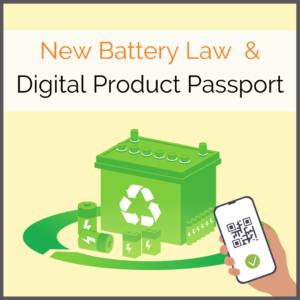
Worldwide, around half of all greenhouse gas emissions are released solely through the extraction and processing of raw materials. These processes are essential to the linear economic model that has been established for decades. Natural resources are extracted, processed into products, and then discarded shortly thereafter. As a result, a significant number of valuable resources is simply lost. Improving these conditions would have a clearly positive impact on our environment. This is particularly true for batteries, which often contain rare metals. The battery passport – i.e., the Digital Product Passport (DPP) for batteries – is intended to promote the reuse and recycling of these rare earth materials.
Three legislative frameworks aim to contribute to more sustainable resource usage: the EU’s Ecodesign for Sustainable Products Regulation (ESPR), Germany’s Battery Act 2 (BattG2), and the EU Battery Regulation (EU BattV). All three seek to counteract the unnecessary waste of raw materials. Through the ESPR and BattG2/EU BattV, a framework is being established for ecodesign and sustainability requirements for specific products. The goal is to conserve resources and energy through a circular economy.
To achieve this objective, a digital product passport is being introduced. Every product that falls under BattG2 and the ESPR must be labeled in such a way that it can be tracked and identified. Sustainability and product lifecycle data will thus become accessible to all participants in the supply chain.
The New Battery Legislation – BattG2 and EU Battery Regulation
Germany’s Battery Act 2 (BattG2) is based on the former EU Battery Directive 2006/66/EC. The original Battery Act was revised in January 2021, and BattG2 came into force. The previously separate Battery Act Implementation Ordinance (BattGDV) was integrated into BattG2. BattG2 regulates the placing on the market, take-back, and disposal of batteries and accumulators, regardless of whether they are incorporated into devices or sold separately.
The EU Battery Regulation (EU) 2023/1542 applies directly in all EU member states. It harmonizes requirements across the EU and, through the battery passport (Digital Product Passport, DPP), creates greater transparency and traceability.
The legislation requires manufacturers, importers, and foreign suppliers to register with the German Electrical and Electronic Equipment Register (EAR) operated by the EAR Foundation before placing products on the market. The take-back of batteries is also regulated by BattG2; manufacturers must participate in an approved take-back scheme. In addition, the legislation mandates battery labeling as of 18 August 2026. The Digital Product Passport (DPP) for certain batteries is intended to make battery handling and recycling more transparent.
Implications of the Battery Law for Manufacturers
On the one hand, the battery legislation represents an important step toward sustainability. On the other hand, it introduces significant market disruption. Given the scale of the changes and the number of affected products, it quickly becomes clear that manufacturers face major challenges – especially companies that have previously had little exposure to European regulations. Nevertheless, while the requirements are complex, they are manageable with the right support.
Cordless drills, electric toothbrushes, and lighters must be labeled. For other devices and batteries, a Digital Product Passport will also be mandatory. Particularly for small and medium-sized enterprises, these additional requirements can constitute a substantial burden. It is therefore essential to address BattG2 early and, if necessary, involve experienced partners at an early stage.
The EU Battery Regulation differentiates between manufacturers, authorized representatives, importers, and fulfillment service providers, each of whom has different obligations. From a regulatory perspective, companies may be classified as manufacturers for the first time – possibly without realizing it. Under regulatory definitions, the manufacturer is the party that first places batteries on the market in a given country or region. Importers of batteries or electronic devices containing batteries may therefore be considered manufacturers and must comply with the corresponding requirements.
What Information Does the Battery Passport Contain?
The requirements of the Battery Passport (DPP) apply to industrial batteries with a capacity of more than 2 kWh, electric vehicle batteries, and LMT batteries (e.g., those installed in e-bikes or e-scooters). Small devices such as lighters or electric toothbrushes are subject to labeling requirements but do not require a battery passport.
The battery passport will contain a wide range of information – 28 data points in total. These include general information such as manufacturer details, weight, and capacity. More specific data must also be provided, including the carbon footprint, minimum, nominal, and maximum voltage, as well as the EU declaration of conformity. All of this information must be included in the labeling required from August 2026 and made accessible via a QR code from February 2027.
Although the initial form of labeling is not specified, a QR code is well suited for this purpose. Depending on battery size, labeling requirements may pose an additional challenge, as QR codes must comply with ISO standard 18004 and have a minimum size of 1 cm × 1 cm.
The detailed requirements are listed in Annex XIII of the regulation.
Ecodesign for Sustainable Products Regulation (ESPR)
The Ecodesign for Sustainable Products Regulation (ESPR) entered into force in 2024 with the aim of making the EU market more sustainable. It replaced the Ecodesign Directive (2009/125/EC) and introduced stricter ecodesign criteria for a broader range of products. Implementation is being carried out step by step through delegated acts for individual product groups, with batteries being the first category addressed.
The Digital Product Passport is a digital record containing information on a product’s environmental sustainability – such as durability, repairability, recycled content, and availability of spare parts. Hence, the battery passport effectively serves as the prototype for the EU-wide Digital Product Passport. The DPP is intended to:
- support consumers and businesses in purchasing decisions,
- facilitate repair and recycling,
- increase transparency regarding the environmental impacts of products throughout their lifecycle, and
- assist authorities in carrying out compliance checks.
Transparency Through Track-and-Trace Under Battery Legislation
The Battery Passport and the Digital Product Passport function as track-and-trace systems, providing information on a product’s origin, composition, and repair and recycling options. This transparency enables consumers to choose more sustainable products and creates added value for responsibly manufactured goods. Waste management companies also benefit, as they receive clear guidance on disassembly and recycling. All stakeholders are thus empowered to take a more active role in the transition toward a future-oriented economy.
Implementing a track-and-trace system requires each individual product to be assigned a (usually randomized) serial number. Requirements and regulations are continuously evolving, making track-and-trace an ongoing project that requires long-term attention. The DPP is not just about a label; it is a comprehensive data management project covering the entire product lifecycle.
Although transparency is a central goal of the DPP, not all data stored in the passport will be publicly accessible. A distinction is made between public data, restricted data, and data that must be made available exclusively to authorities.
How We Support You
This is where we come in. We support our customers with a DPP software solution that is continuously updated to reflect current regulations. This allows you to focus on your business without worrying about regulatory compliance.
Advantages of tracekey for DPP Implementation
tracekey has already supported the implementation of track-and-trace systems in two industries. Drawing on experience from pharmaceutical serialization and UDI implementation for medical technology, we are experts in product digitization. As a SaaS provider, our goal is to simplify our customers’ work. With state-of-the-art software technology and a team of experienced experts, we help our customers overcome the challenges of digitization and achieve regulatory compliance with ease.
[Disclaimer]
The information provided represents only one possible interpretation of the applicable regulations. As these regulations are subject to continuous change, the information in this article may be incomplete or no longer up to date. This article does not constitute legal advice. Please consult official regulatory documents before making any business decisions.
(Information status: April 2026)